When wet clay swells against a basement wall, the wall has nowhere to go but inward. The bow starts small, then doors stick, cracks stair-step across the block, and water finds the seams. Bowing basement wall repair in Lebanon, TN uses anchors, braces, or carbon fiber to stop the movement and hold the wall where it belongs.
Quick Answer: A bowing wall is stabilized with anchors, steel braces, or carbon fiber, chosen by how far the wall has moved. Carbon fiber runs $3,500-$7,500 for early bowing, and anchors typically cost $500-$1,000 each. The inspection and measurement are free.
A basement wall is a retaining wall, and every retaining wall has a load limit. In Lebanon, that limit is tested by expansive Middle Tennessee clay. When the clay is dry it shrinks and pulls away from the foundation, but when heavy spring rain saturates it, the clay swells with tremendous lateral force against the wall. Add groundwater pushing from below, a pattern called hydrostatic pressure, and the wall is squeezed from two directions at once.
The wall usually gives way at its weakest point, which is mid-height, where it is farthest from the footing below and the floor framing above. On block walls, the mortar joints crack first, producing the stair-step pattern that runs across the courses. On poured concrete walls, a horizontal crack opens along the line of greatest pressure. Either way, the bow starts small, often less than an inch, and grows a little with every wet season. A wall that has bowed once will not straighten on its own when the soil dries, because the clay never returns the wall to plumb.
Drainage decides how fast it happens. Downspouts that dump at the foundation, grading that slopes toward the house, and clogged exterior drains all keep the soil against the wall wetter for longer, which means more swelling and more pressure. That is why a good wall repair plan always looks at water first: stabilizing the wall without fixing the drainage is like bracing a door while someone keeps pushing on it. The inspection measures the deflection, traces the water, and only then recommends a system.
A bowing wall gives warning for years before it becomes a structural emergency. These are the signs worth measuring, not ignoring.
A crack running horizontally along the wall, usually at or near mid-height, is the classic signature of soil pressure. It marks the line where the wall is bending inward under the load.
Cracks that follow the mortar joints in a stair-step pattern mean the block courses are shifting against each other. On older Lebanon block walls, this is often the first visible sign of bowing.
Stand at one end of the wall and sight along it. A bow shows as a bulge or lean toward the room, usually greatest at mid-height. Even a lean you can barely see is worth measuring.
When a wall moves, the framing above it moves too. Doors and windows on that side of the house start sticking, jamming, or showing uneven gaps around the frame.
Water seeping in where the wall meets the floor, or damp staining along the base, means pressure is forcing water through the same seams the soil is pushing open. The water and the movement share a cause.
Cracks that open wider after wet months and narrow slightly in dry ones are tracking active movement. Marking a crack and re-checking it after a rainy season is the simplest test a homeowner can do.
A wall anchor is a simple idea executed with precision. A steel earth anchor plate is buried in stable soil well outside the zone of pressure, a high-strength steel rod runs from that plate through the wall, and a steel wall plate spreads the load across the inside face. Tightening the rod pulls the wall against the anchor, and the anchor holds it there, transferring the soil load into ground that does not move. Anchors are spaced along the bow, usually several feet apart, so the whole wall is carried, not just one spot.
Anchors suit walls that have bowed past the early stage, or walls that are still moving. Unlike carbon fiber, which bonds to the wall surface and holds it in place, anchors work mechanically and can be tightened gradually across seasons, which sometimes recovers a portion of the bow. Where exterior access is limited, for example where a driveway or patio sits against the wall, steel I-beam braces are the alternative: vertical beams anchored to the footing and the floor framing above, bracing the wall from inside.
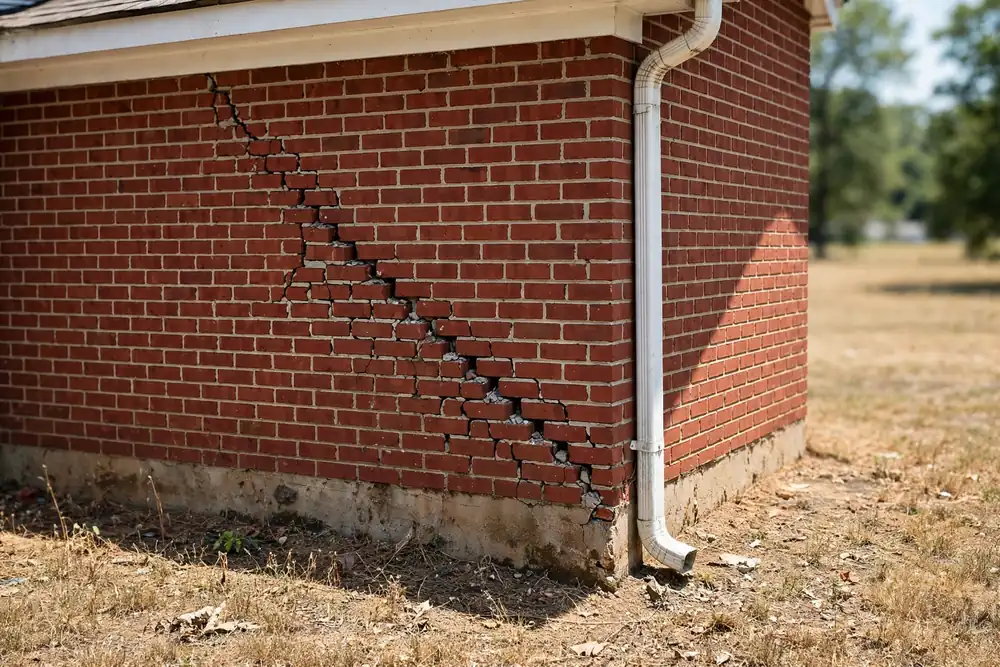
Stair-step cracking like this is the classic signature of differential settlement on Wilson County clay.
Good foundation wall repair Lebanon TN practice starts with measuring the deflection before choosing a system, and that measurement is what the free inspection delivers. Bowing under 2 inches with a wall that has stopped moving usually calls for carbon fiber reinforcement: high-strength straps bonded to the wall that prevent further inward movement without excavation. Bowing past 2 inches, or a wall still creeping inward each wet season, calls for anchors or braces. Either way, drainage is addressed in the same plan, because a stabilized wall beside saturated clay is still a wall under load.
One honest note: no system makes a bowed wall new again. The goal is a wall that no longer moves, documented with before-and-after measurements you can show a buyer or a home inspector. Anchors can recover some of the bow over time, but the critical outcome is stability, and the written evaluation says plainly what your wall can and cannot be expected to do.
Four steps, in the same order on every job. You know what happens next before it happens.
We measure how far the wall has moved, map the crack pattern, and trace the water and drainage conditions driving the pressure, so the system fits the failure.
You receive a written evaluation: the deflection readings, the recommended system, and what each part does, with an exact price, before any work is scheduled.
Anchors, steel braces, or carbon fiber are installed in the sequence the diagnosis requires, with drainage corrections made alongside, so the wall is stabilized and the pressure is relieved together.
Work areas are restored, and you keep the full record: deflection readings, anchor or brace locations, and the repair plan, for your home's file and for future buyers.
Every home requires a free on-site deflection measurement to determine exact repair needs, but these typical price ranges help Lebanon homeowners plan ahead:
| Repair Service | Common Problem Solved | Estimated Price Range |
|---|---|---|
| Carbon Fiber Wall Reinforcement | Early-stage inward basement wall bowing (less than 2 inches) | $3,500-$7,500 |
| Wall Anchors (per anchor) | Moderate to severe bowing, walls still moving | $500-$1,000 per anchor typical |
| Steel I-Beam Wall Braces (per beam) | Bowing walls where exterior excavation is limited | $500-$800 per beam typical |
| Epoxy / Polyurethane Crack Injection | Non-structural vertical hairline wall leaks | $600-$1,250 |
| Steel Push Piers / Helical Piers | Settlement pulling the wall out of plumb | $1,600-$2,800 per pier |
Ranges marked typical are widely published U.S. averages for planning. Your exact price comes from the free on-site measurement, which accounts for wall length, deflection, access, and drainage needs.
The basements most at risk in Lebanon are the oldest ones. Around the historic square and Cumberland University, block and stone basement walls have stood for a century, and their mortar joints have had a century of wet seasons to weaken. When expansive clay swells against a wall like that, the joints give way before the block does, which is why stair-step cracking is the signature failure on these older homes. A wall that has carried its load for decades can start moving in a single wet spring.
The ground itself is the other half of the story. Lebanon sits on expansive clay over karst limestone, and the limestone drains unevenly, so groundwater collects in pockets against some walls and not others. Low ground near Bartons Creek, along Coles Ferry Pike, and in the Highway 109 corridor holds water longer after storms, and the newer subdivisions along I-40 add a different problem: backfill around freshly built basements settles and holds water against walls that have not yet had time to cure fully. Wherever the soil stays wet, the pressure stays on.
Older block and stone basements near the historic square have mortar joints weakened by decades of wet seasons. Stair-step cracking is their signature failure pattern.
Middle Tennessee clay swells with tremendous lateral force when saturated, pushing directly against basement walls. Dry summers shrink it away, then wet springs push it back.
Spring storms saturate the ground and raise the water table, adding hydrostatic pressure from below to the clay pressure from the side. Poor drainage multiplies both.
Carbon fiber reinforcement for early-stage bowing typically runs $3,500 to $7,500 for a wall, while wall anchors typically cost $500 to $1,000 per anchor, with most walls needing several anchors spaced along the bow. Steel I-beam braces typically run $500 to $800 per beam. The total depends on the wall length, how far it has moved, and whether drainage work is needed. A free on-site deflection measurement gives the exact price.
Wall anchors can sometimes pull a bowed wall back toward plumb over time, because the anchor rods are tightened gradually across seasons. Carbon fiber and steel braces are designed to hold a wall in place and stop further movement rather than to straighten it. The realistic goal on most jobs is a wall that no longer moves, with partial straightening as a bonus where the wall and the soil allow it.
A basement wall bows when the soil outside pushes harder than the wall can resist. In Lebanon the usual driver is expansive clay that swells when wet, combined with hydrostatic pressure from groundwater and poor drainage. Heavy spring rain saturates the clay, the clay expands against the wall, and the wall bends inward at its weakest point, usually mid-height. Older block walls are especially vulnerable because the mortar joints give way first.
The choice comes down to how far the wall has moved, which the inspection measures. Carbon fiber reinforcement suits early-stage bowing of less than 2 inches, where the wall is still largely straight and needs to be held. Bowing past 2 inches, or a wall that is still moving, usually calls for wall anchors or steel I-beam braces, which carry the soil load mechanically. The measurement, not a guess, decides the system.